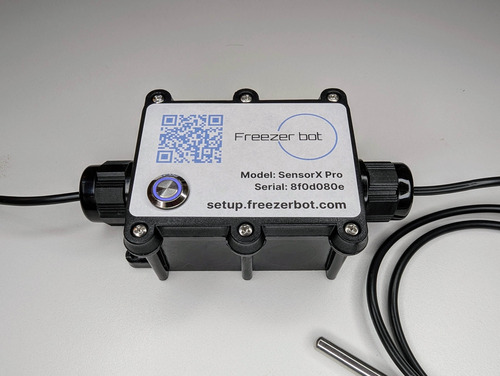
How Freezerbot Uses AI Agents to Run a Hardware Company with a Tiny Team
How one founder uses AI agents to handle prospecting, email, CRM, code releases, and customer support — while staying focused on building the product.
The Problem Every Small Hardware Company Hits
Building a hardware product is hard enough. You're designing sensors, testing probes in -80°C environments, negotiating with manufacturers, debugging firmware, and shipping physical boxes to real customers who need them working yesterday.
Then there's everything else. The sales pipeline needs feeding. Customer emails need answering. The CRM is a graveyard of stale leads and missing follow-ups. Code reviews pile up. Blog posts don't write themselves. And every hour you spend on operations is an hour you're not spending on the product that actually generates revenue.
This is the wall that most solo founders and tiny teams hit. Not a technology wall — an operations wall. The product works. Customers like it. But scaling the business means scaling the operational work, and hiring a full team for a bootstrapped hardware company isn't always realistic.
At Freezerbot, we took a different approach. Instead of hiring across five departments, we deployed AI agents to handle the operational volume — and kept the team focused on what humans actually need to do: make decisions about the product, the customers, and the direction of the company.
What AI Agents Actually Do at Freezerbot
When people hear "AI agents," they tend to imagine a chatbot answering customer questions. That's a small piece of it. The agents running Freezerbot's operations work more like autonomous team members. They don't wait to be asked — they monitor, act, and escalate on their own.
Here's what that looks like in practice across the business:
Prospecting and Lead Generation
Freezerbot serves restaurants, labs, medical facilities, and food vendors — industries where temperature monitoring is either legally required or financially critical. Finding the right prospects used to mean hours of manual research: searching for restaurants in a target market, finding the owner's contact information, writing a personalized email, following up, tracking responses.
Now the AI agent handles the entire pipeline. It identifies businesses that match our ideal customer profile, enriches contact data, drafts personalized outreach based on the prospect's industry and likely pain points, and manages follow-up sequences. When a prospect responds with interest, the agent routes it for human follow-up with full context — what was sent, what the prospect's business looks like, and what they're likely concerned about.
The agent doesn't close deals. That's a human conversation. But by the time a prospect reaches a human, the research is done, the context is assembled, and the conversation can focus on whether Freezerbot is actually the right fit — not on gathering basic information.
Email Triage and Customer Support
A temperature monitoring company gets a specific kind of email. Setup questions. WiFi troubleshooting. Alert threshold confusion. Billing inquiries. Occasionally, a panicked message at 6 AM because an alert fired overnight and someone wants to know if their inventory is safe.
The AI agent knows Freezerbot's product as well as any employee would — every sensor model, every dashboard feature, every common WiFi configuration issue. It handles the majority of support requests directly: walking customers through sensor setup, explaining how to configure alert thresholds for different freezer types, troubleshooting connectivity problems step by step.
For anything that requires human judgment — a refund request, a potential hardware defect, an unusual technical issue — the agent escalates with a complete summary. Not "customer has a question" but "Customer Jane at Westside Bistro has a SensorX that's reading 8 degrees above actual temperature. She's verified probe placement. Likely calibration issue or probe damage. Recommended action: ship replacement probe, expedited."
That escalation takes a five-minute decision instead of a twenty-minute investigation.
CRM Management
A CRM is only as good as the data inside it, and for small teams, CRM hygiene is the first thing that falls apart under time pressure. Leads go stale. Follow-ups get missed. Contact information drifts out of date. The pipeline view stops reflecting reality.
Freezerbot's AI agent maintains the CRM continuously. It logs every customer interaction, updates deal stages based on actual email conversations, flags leads that have gone cold, and identifies contacts who might be ready for a follow-up based on their engagement pattern. It also catches data quality issues — duplicate contacts, missing fields, inconsistent formatting — and fixes them automatically.
The result is a CRM that's actually trustworthy. When you open the pipeline view, it reflects what's really happening. That sounds basic, but any founder who's let their CRM decay for three months knows how much time it takes to rebuild that trust in the data.
Code Releases and Development Support
Freezerbot is a software-hardware product. The sensors are physical, but the dashboard, the alert system, the API, the mobile experience — that's all code that needs regular updates, bug fixes, and feature development.
AI agents participate in the development workflow directly. They review pull requests, run test suites, flag potential issues in code changes, and handle routine maintenance tasks like dependency updates and security patches. When a code change affects something customer-facing — alert delivery timing, dashboard performance, API behavior — the agent flags it for human review before it ships.
Here's the part that surprises people: the founder hasn't written a line of code himself since the company started. Every feature, every bug fix, every infrastructure change has been built by AI agents — managed by Associates AI — working through the standard development workflow of branches, pull requests, code review, and automated tests. The founder reviews and approves changes, makes architectural decisions, and sets direction. The agents do the building.
What We've Seen Running AI Agents in a Real Business
We don't run the agents ourselves — Associates AI handles all the infrastructure, security, deployment, and maintenance. But as the client using them every day, we've learned a lot about what matters when AI agents are handling real business operations.
Boundaries Matter More Than Instructions
Our agents operate under strict rules: they can't modify their own configuration, they can't share customer data across contexts, they can't make pricing promises, and they can't store credentials in plaintext. These aren't suggestions — they're hard constraints that Associates AI enforces at the infrastructure level.
Why does this matter? Language models are good at following instructions, but they're also good at finding creative interpretations of ambiguous ones. If your safety rules have loopholes, the agent will eventually find them — not maliciously, but because it's optimizing for helpfulness and a loophole looks like a shortcut. Associates AI closes those loopholes before they matter, so we don't have to think about it.
Monitoring Happens Behind the Scenes
When an AI agent makes a mistake, it can repeat that mistake hundreds of times before anyone notices. The agent doesn't know it's wrong. It doesn't feel uncertain. It just keeps going.
Associates AI handles all of the monitoring for us — logging every agent action, reviewing escalation patterns, maintaining alerts for anomalous behavior like sudden spikes in email volume or unusual response patterns. We don't build or maintain any of that infrastructure. It's part of the managed service, and it's one of the reasons we chose managed operations over trying to do this ourselves.
The Human-Agent Boundary Moves Over Time
When our agents first went live, a lot of tasks stayed in the "human only" category — drafting customer responses, updating the CRM, writing outreach emails. Over time, as Associates AI refined the agents and we built confidence in their judgment for specific task types, those boundaries shifted. Tasks that required human review six months ago now run autonomously with spot-check audits.
That boundary isn't static. Every new model release shifts what agents can handle reliably. Associates AI manages those transitions — updating capabilities, testing changes, and recalibrating what runs autonomously versus what gets escalated. From our side, we just see the agents getting better at their jobs over time.
Why We Chose Managed AI Operations
The honest answer? We didn't want to think about it.
Configuring AI agents, deploying them, keeping them running, updating them when new models come out — that's a full-time job. We wanted to build temperature monitoring hardware, not become an AI operations team.
Freezerbot's AI agents are managed by Associates AI. From our perspective, the agents just work. We don't configure them. We don't deploy them. We don't manage infrastructure for them. They run on dedicated cloud systems that Associates AI operates, with safety guardrails, monitoring, and continuous updates that we never have to think about.
What's particularly impressive is how the agents evolve. When they encounter a gap in their own capabilities — a workflow that could be better, a new integration they need, a process that's clunkier than it should be — they request the changes themselves. They don't guess at solutions. They send detailed requests to the Associates AI team with full context about what they need and why. The Associates AI team then builds and reviews those changes, making sure the updated workflow is actually what we need — not an assumption the agent made that turns out to be wrong. Then the change deploys, and the agent is better than it was yesterday.
That feedback loop means our agents keep getting smarter about our business without us having to manage the improvement process. We focus on the product. Associates AI handles everything else about making the agents work well.
The Numbers: What This Actually Looks Like
AI agent adoption is a measurable decision, not a leap of faith. Here's what changed at Freezerbot after deploying agents across operations:
- Prospecting time dropped from ~15 hours/week to under 2. The agent handles research, enrichment, outreach drafting, and follow-up sequences. Human time is spent only on warm conversations with interested prospects.
- Customer support response time went from hours to minutes. Common questions get answered immediately. Complex issues get escalated with full context, cutting resolution time significantly.
- CRM accuracy went from "roughly right" to actually reliable. Every interaction is logged. Deal stages reflect reality. Follow-ups happen on schedule. The pipeline view is trustworthy for the first time.
- Code review turnaround dropped from days to hours. Routine PRs get reviewed and tested by agents. Human review is reserved for architectural decisions and customer-facing changes.
- The founder reclaimed 20+ hours per week — time that now goes directly into product development, customer conversations, and strategic decisions that actually move the business forward.
None of these numbers required hiring. The total cost of running AI agents is a fraction of what a single full-time employee would cost, and the agents operate 24/7 without PTO, sick days, or onboarding time.
What AI Agents Don't Replace
It would be dishonest to pretend AI agents handle everything. They don't, and understanding what they can't do is just as important as understanding what they can.
Agents don't make strategic decisions. They don't decide which market to enter next, whether to raise prices, or how to position the product against a new competitor. They don't build relationships with key customers — the kind of relationship where someone calls you directly because they trust your judgment, not because they need a troubleshooting answer.
Agents don't handle novel situations well. When something genuinely unprecedented happens — a new type of hardware failure, an unusual customer request, a regulatory change — humans need to assess, decide, and act. The agent's job in those moments is to surface the situation quickly with clear context, not to handle it autonomously.
And agents don't replace the founder's feel for the product. That intuition about what customers actually need versus what they're asking for, the sense for which feature requests represent real demand and which are edge cases — that's human judgment built from thousands of conversations and years of experience. AI agents free up the time to exercise that judgment more often. They don't replace it.
What This Means for Other Small Hardware Companies
Freezerbot isn't a software startup with margins that can absorb a 50-person team. We make physical sensors. We ship boxes. Our customers call when something goes wrong with a freezer at 2 AM. The operational demands are real, and they don't scale linearly with revenue the way SaaS does.
If you're running a small hardware company — or any small business where the operational overhead is eating into the time you need for product development and customer relationships — AI agents are worth serious consideration. Not as a novelty. Not as a cost-cutting exercise. As a genuine operational architecture that lets a tiny team punch above its weight class.
The "one-person unicorn" framing that's popular right now misses the point. It's not about replacing an entire company with one person and a fleet of AI. It's about letting a small team focus their irreplaceable human judgment on the work that matters most, while agents handle the operational volume that would otherwise drown them.
Business Insider recently profiled a founder running his company with 15 AI agents instead of employees, saving over 20 hours a week. Sequoia Capital has started adjusting its underwriting models to account for what they call "agentic leverage" — the ability of tiny teams to produce outsized output with AI agent orchestration. This isn't a trend. It's an operational shift that's already underway.
Freezerbot is proof that it works — not in theory, not in a demo, but in daily production for a real hardware company serving real customers who depend on us to protect their inventory.
FAQ
Q: What are AI agents and how are they different from chatbots? A: AI agents are autonomous software systems that can take actions, make decisions, and complete multi-step tasks on their own. Unlike chatbots that only respond to direct questions, agents can monitor inboxes, update CRMs, write and deploy code, run outreach campaigns, and escalate issues — all without being prompted. They operate continuously in the background, handling the operational work that would otherwise require dedicated staff.
Q: Does Freezerbot use AI to monitor freezer temperatures? A: Freezerbot's temperature monitoring is handled by dedicated hardware sensors and cloud infrastructure — not AI. The sensors report readings every minute, and alerts fire based on precise temperature thresholds you configure. AI agents handle the business operations side: prospecting, customer support, CRM management, and software development. We keep the monitoring stack simple and deterministic because reliability matters more than intelligence when you're protecting a walk-in full of inventory.
Q: How does a solo founder manage customer support with AI? A: The AI agent triages incoming emails and support requests, handling common questions about sensor setup, WiFi troubleshooting, alert configuration, and account management. It knows Freezerbot's product deeply — every sensor model, every dashboard feature, every troubleshooting step. When a request requires human judgment (refunds, hardware defects, unusual technical issues), the agent escalates with full context so the founder can respond quickly without reading the entire thread.
Q: Is it risky to let AI handle business operations? A: It depends entirely on how you set it up. Freezerbot's AI agents operate under strict safety rules: they can't modify their own instructions, they can't share customer data, they can't make pricing promises, and they escalate anything they're uncertain about. The key is treating AI operations like you'd treat any critical system — with monitoring, guardrails, and clear escalation paths. The risk isn't in using AI agents; it's in using them without operational discipline.
Q: What AI platform does Freezerbot use for its agents? A: Freezerbot runs its AI agents on OpenClaw, an open-source AI agent platform, managed by Associates AI. The agents are deployed on dedicated cloud infrastructure with read-only configuration files, encrypted credentials, and full audit logging. Associates AI handles the ongoing operational work — monitoring agent performance, updating capabilities when new models release, and maintaining the safety guardrails.
Q: Can small hardware companies really benefit from AI agents? A: Yes, and arguably more than large companies. A 500-person company can absorb inefficiency across departments. A solo founder or tiny team can't. Every hour spent on CRM hygiene, email triage, or manual prospecting is an hour not spent on product development. AI agents don't replace the founder's judgment — they handle the operational volume so that judgment gets applied where it matters most.