Why Laboratory Freezer Monitoring Matters
For research labs, biorepositories, pharmaceutical facilities, and hospital laboratories,
a single temperature excursion inside a freezer can be catastrophic. Irreplaceable biospecimens,
decades of research samples, expensive reagents, and life-saving vaccines can be destroyed in hours
— often overnight or over a holiday weekend when no one is present.
The financial impact is significant. Replacing a full -80°C freezer's worth of reagents and
biospecimens can cost $10,000 to $50,000 or more. Beyond direct replacement
costs, sample loss means delayed experiments, repeated patient collections, broken clinical
trial timelines, and potential regulatory citations. For many labs, the samples simply
cannot be replaced at any cost.
A robust laboratory freezer monitoring system catches problems early —
typically within minutes of an equipment failure, door-seal issue, or power outage —
giving staff time to transfer samples to backup storage before temperatures reach damaging levels.
What to Look for in a Lab Freezer Temperature Monitoring System
Not all temperature monitoring systems are built for laboratory environments. When evaluating
lab freezer temperature monitoring solutions, look for these capabilities:
-
Ultra-low temperature support — Your system must reliably operate inside
-80°C (and colder) ultra-low temperature (ULT) freezers. Many consumer-grade sensors
fail below -40°C. Freezerbot's probes are rated for ULT environments and tested for
lab-grade reliability.
-
Continuous, automated logging — Manual temperature logs — paper binders,
spreadsheets, someone writing numbers on a clipboard — are error-prone, incomplete,
and impossible to audit effectively. A proper system logs every reading automatically,
every minute, with a tamper-proof timestamp.
-
Instant, escalating alerts — When a freezer goes out of range at 2 AM
on a Saturday, someone needs to know immediately. Alerts should reach the right people
by push notification, email, and SMS — and should escalate if the first contact doesn't respond.
-
Multi-unit, multi-location dashboard — Most labs operate multiple
freezers across multiple rooms or buildings. A single dashboard showing all units
in real time is far more practical than managing individual devices.
-
Audit-ready reports — Regulators and accreditation inspectors expect
complete, exportable temperature records. Your system should produce these on demand.
How Freezerbot Works for Lab Cold Storage Monitoring
Freezerbot is a wireless lab cold storage monitoring system designed for
simplicity without sacrificing reliability. Here's how it works:
-
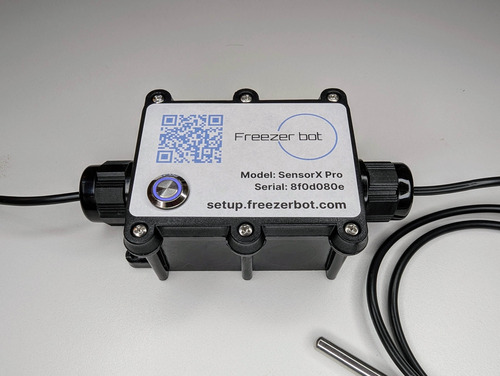
Sensor hardware — Each Freezerbot sensor unit mounts outside the freezer
(protecting the electronics) while a durable, water-resistant probe routes inside to
sit directly in the storage compartment. The probe is rated for ULT environments, including
-80°C ultra-low freezers.
-
WiFi connectivity — Sensors connect to your facility's WiFi network.
You can configure multiple networks for redundancy — important in labs where network
outages can't be allowed to create monitoring gaps.
-
Cloud dashboard — Temperature readings flow to the Freezerbot cloud
every minute. Access real-time temperatures, historical graphs, and alert history from
any browser or mobile device.
-
Configurable alerts — Set custom temperature thresholds for each
freezer — a -80°C ULT has very different alert parameters than a standard -20°C
chest freezer. Assign alerts to specific people by sensor so the right technician
is notified for each unit.
-
Automated audit logs — Every reading is logged with a precise timestamp.
Logs are stored securely in the cloud and exportable on demand — ready for your
next accreditation visit.
Compliance & Audit Logs for Research Labs
Research labs and medical facilities face a complex web of regulatory requirements for
temperature monitoring documentation. JCAHO (The Joint Commission), CAP (College of American
Pathologists), CLIA, and state health departments all require that labs demonstrate continuous,
documented temperature control for specimens, medications, and reagents.
Historically, this meant someone physically checked and recorded temperatures twice a day,
creating paper binders that were easy to lose, difficult to search, and impossible to use
as real evidence of continuous monitoring. Modern laboratory freezer alarm systems
like Freezerbot replace paper entirely.
Freezerbot automatically logs every temperature reading with a timestamp, maintaining a
complete, unbroken record from the moment you install the sensor. When an inspector asks
for six months of temperature data for your -80°C freezer, your lab manager can export
it from the dashboard in minutes — not hours of searching through paper binders.
-80°C Ultra-Low Freezer Support
Ultra-low temperature (ULT) freezers operating at -80°C are the workhorses of modern
research — holding cell lines, tissue samples, enzymes, DNA/RNA, plasma, and other
temperature-sensitive materials that cannot be replaced if lost.
Most low-cost temperature sensors are not rated for ULT environments. Freezerbot sensors
use a probe specifically designed for extreme cold, reliably reporting accurate temperatures
at -80°C and below. The sensor electronics mount outside the freezer door where they're
protected from the extreme temperature while the probe does its job inside.
Because ULT freezers are so critical — and because the contents are so valuable — we
recommend the SensorX Pro model for ULT applications. Its built-in battery
backup continues monitoring even during power outages, giving you the critical window
needed to respond before -80°C samples warm to damaging temperatures.
Alert Configuration for Freezer Monitoring in Research Labs
Not all freezers in a research lab need the same alert thresholds. A pharmaceutical
stability freezer holding investigational drugs has very different requirements than a
backup freezer holding non-critical supplies. Freezerbot lets you configure:
- Custom min/max thresholds per sensor — set the exact range appropriate for the contents of each unit
- Alert recipients per sensor — the person responsible for the -80°C biospecimen freezer may be different from the one who manages the reagent cold room
- Multiple notification channels — push notifications, email, and SMS so alerts reach people regardless of whether they're at their desk
For high-value ULT freezers, we recommend setting alerts conservatively — for example,
alerting at -70°C for a -80°C freezer — so staff have time to respond before temperatures
approach truly damaging levels.
Installation: How Fast Can You Deploy?
One of the most common objections to new monitoring equipment in research environments is
IT complexity: "We need to file a ticket, get network access, set up VLANs…" Freezerbot
sidesteps this entirely.
Installation takes under 10 minutes per freezer:
- Plug the sensor into a standard outlet near the freezer
- Route the temperature probe inside the freezer compartment
- Use the Freezerbot app to connect to your lab WiFi
- Name the sensor (e.g., "Lab 3 - ULT Freezer 2") and set your alert thresholds
- Done — the dashboard starts receiving readings immediately
No IT involvement required. No special network configuration. No installation fees.
Most labs are fully deployed within a single afternoon.
Try the demo →
Pricing
Freezerbot sensors start at $99 with the first six months of monitoring
included. The SensorX Pro — with battery backup for ULT and mission-critical applications —
is also available. Ongoing monitoring is subscription-based and priced per sensor.
When a single ULT freezer failure can cost tens of thousands of dollars in lost samples,
the return on investment is typically realized the first time an alert saves a sample set.
Many labs tell us Freezerbot paid for itself within the first month.
See current pricing and available sensors →